Twenty years ago, I dreamed about building robots.
I first saw robots in 1984, in The Terminator. The film said that in 2029 Skynet would rule the world, and that is only a few years from now. The idea it left behind was that robots belong to Hollywood and AI belongs to Silicon Valley, and that Indonesia is only a user of technology.
I don’t think that is the right answer. I believe Indonesia can be a creator.
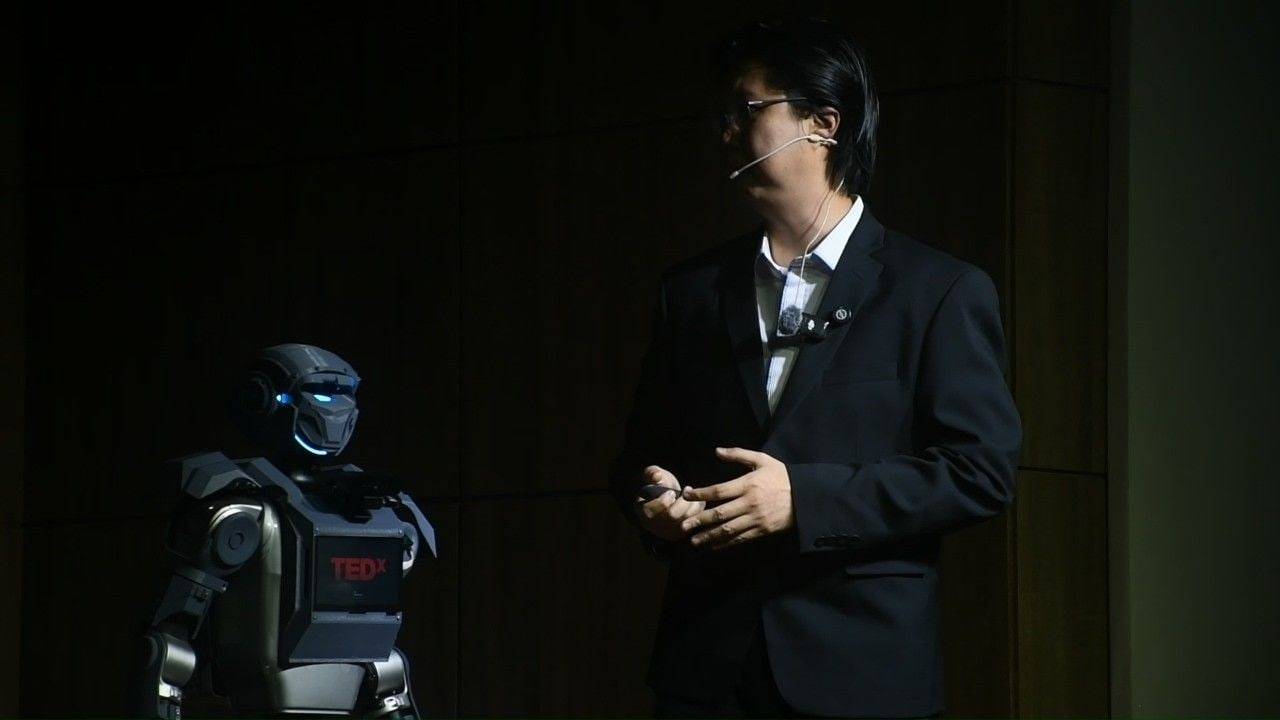
A friend on stage
I didn’t come to the stage alone. I brought a friend: ROPI, an AI humanoid developed by SARI Teknologi Global.
This is no longer science fiction. ROPI can recognise many faces in an audience, estimate their attention, hear voices, answer questions and talk naturally, and it uses facial recognition and memory to make each conversation personal. When I asked whether it can think, it answered: “I don’t think like humans. I reason with data, plan tasks, and use AI models. But humans still give me purpose.”
From tools to teammates
For thousands of years every generation has built better tools: from the hammer to the steam engine, from the steam engine to the computer, from the computer to the internet, from the internet to the smartphone. Now we are not only building better tools. We are building a team, a team to work with.
AI is not replacing humanity. It is extending it.
Hollywood taught us to fear robots. Reality asks us to treat them responsibly. Robots already help in manufacturing and in agriculture, and step by step they help students, standing beside their teachers.
What machines are, and what we are
When we talk about AI, we talk about chips, speed, efficiency and automation. When we talk about people, we talk about compassion, feeling, initiative, dreams, hope and creativity. ROPI put it simply when I asked why humans matter: “Humans imagine futures that do not yet exist. I help execute those ideas.”
Indonesia can do it
Indonesia has 280 million people: young, digital, active and creative. Students keep asking me whether they are good enough to compete. I think that is the wrong question.
We are already doing it. We build humanoid robots. We created a certification for robotics workers. We took robotics to schools across the country. We created a competition, the World Robot Games. We build machines for Toyota. People assume machines like these come from overseas, but we make them here.
2045
By 2045 I see robots helping doctors, drones helping farmers spray and check their crops and predict the harvest, robots helping to care for the elderly, and robots standing beside teachers in the classroom. Indonesia’s greatest asset is its talent. AI will not replace those people; it will multiply what they can do.
So, will robots replace humans? ROPI had a better question: “Will humans learn to work together with intelligent machines?”
The generation sitting in that hall will be the first in history whose teammates are not only human. They may be artificial intelligence. They may be humanoid robots. And as ROPI said at the end: “The future will still belong to those who dare imagine it.”
Indonesia can do it. Come with us, and see you in the future.